


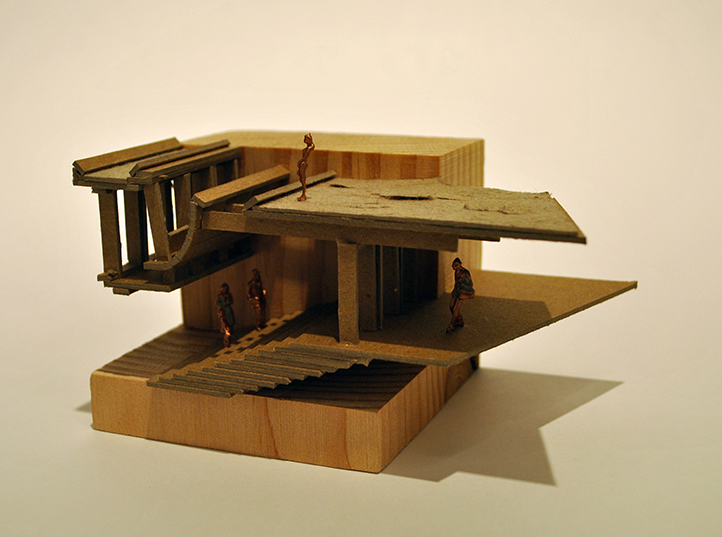
We approached the need for community space in the Cleveland Park neighborhood of East Nashville with the same ethos in which I’ve developed this collection of work: with an emphasis on honesty and an acknowledgment that the project is forever changing and never complete. On the chosen site currently sits two church buildings, one that still hosts a congregation and one that does not. These buildings represent three distinct chapters in the story of this site in which the needs of the community changed and the environment was made to respond. This adaptation and addition, including community gathering, restaurant, retail space, library, art studios, and art gallery is the fourth chapter in this series of adaptions.
Seeing the site as a sequence of changing space according to needs,WW forces an acknowledgement that this is not the last chapter in its story. The demands of the community will change again and our proposal may no longer be suitable. Thus we worked to design with both reverence for the past and humility to allow for the uncertain future through adaptability.Although one could argue that a warehouse is the most adaptable construction, a warehouse lacks specificity to its tenant. It always feels generic and impersonal. We designed at a variety of scales for specific adaptability, meaning spaces that feel specifically designed for one use that can then be adapted to specifically accommodate another. This is accomplished through a variety of skylights, spatial layouts, and custom furniture pieces.
The form of the 8 limestone clad buildings that host the program are an ode to the featured artist of the art gallery, William Edmondson. A Nashville native, Edmondson would often receive blocks of raw limestone leftover from construction sites which he felt called by God to hand chisel into sculptures. The forms on this site act as monolithic blocks chiseled by the program within it, forming entries, windows and light wells. These carves create light conditions that cater to specific needs.
Transition between these limestone blocks is facilitated by a light bronze and glass facade, revealing visitors’ movement between spaces to the neighborhood and opening up the otherwise opaque construction to the community. In many cases, the limestone is carved away to facilitate circulation. Where visitors ascend or descend into the plazas, a handrail is fashioned into the wall with a thin strip window behind. This allows for a connection with the building and reveals the movement of exploring visitors. Interiors also host many examples of specific adaptability. Windows are set to provide specific kinds of light that are needed for a variety of programs. Things like seating that can be taken and used all over the campus, fold away into the architecture. Each block on the site is connected with a series of plazas, some public and others private. The plazas act as places of orientation with the amenities available, the community within, and the context around. It also forms the stage for the transition from old to new.
The original Grace Baptist Church congregation built its place of worship, brick by brick, until it was finally completed in 1914. As the Cleveland Park neighborhood grew, in 1930, classrooms and community spaces were added around the sanctuary. In 1951, the building within our site was constructed to facilitate more growth but was later sold to Grace Apostolic Church.
Fri 8/23/2024 - Wed 12/04/2024
Grace Apostolic Church // Nashville // TN
36°11’24”N 86°45’50”W
Samuel Curry // Allya Miramontes // Grace Capps
The Fourth Chapter
Adaptive Reuse
RGB 150, 0, 24