Vocation (part 2) [LO-4]
- Samuel Curry
- Nov 24, 2025
- 2 min read

To me, vocation is fundamentally different from profession or career. A profession is the set of skills I practice, and a career is the path I build within that profession, but vocation is the deeper orientation of my life and work toward something meaningful, something that serves others. In architecture, vocation is not simply the act of designing buildings but the commitment to designing for people, with empathy, humility, and a willingness to be shaped by those I serve. This semester has shown me that vocation is less about what I do and more about who I am becoming as I do it.
The virtues we discussed in class, attention, hospitality, patience, and a kind of disciplined humility, have helped me understand how vocation is pursued. These mirror the Christian tradition of service, which calls for seeing every person as made in the image of God and worthy of thoughtful, dignified design. I’ve realized that good architecture cannot happen without this posture. It requires slowing down enough to truly observe, to listen, to “breathe in” a site and a client rather than reducing either to data. I’ve learned that designing from intuition and empathy is not opposed to technical rigor; instead, it keeps our technical work grounded in compassion.
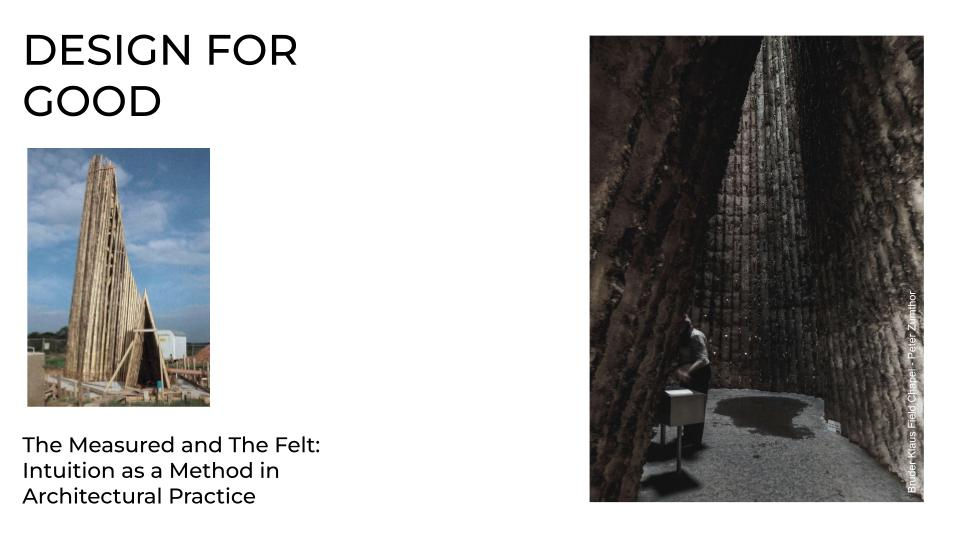
Several experiences have shaped this understanding. Neil Parrish’s talk on vocation underscored that serving others is not just a duty but a source of fulfillment, that the act of design gives back to the designer when it is rooted in love for people. My studies of Peter Zumthor and other intuitive practitioners showed me how presence, quietness, and attention can become architectural methods. And my own semester of site observation, codes research, and studio conversations made it clear that architecture requires a balance of knowledge and unspoken insight, both of which grow out of patient engagement.
This understanding shapes my future by reminding me that I am not simply training for a job, I am learning how to serve. I hope to build a practice someday that honors the dignity of clients and communities, that refuses to rush past the human, and that treats design as an act of care. My vocation in architecture is to create thoughtfully, intuitively, and unselfishly, and this semester has helped me see that path with more clarity and conviction
Comments